
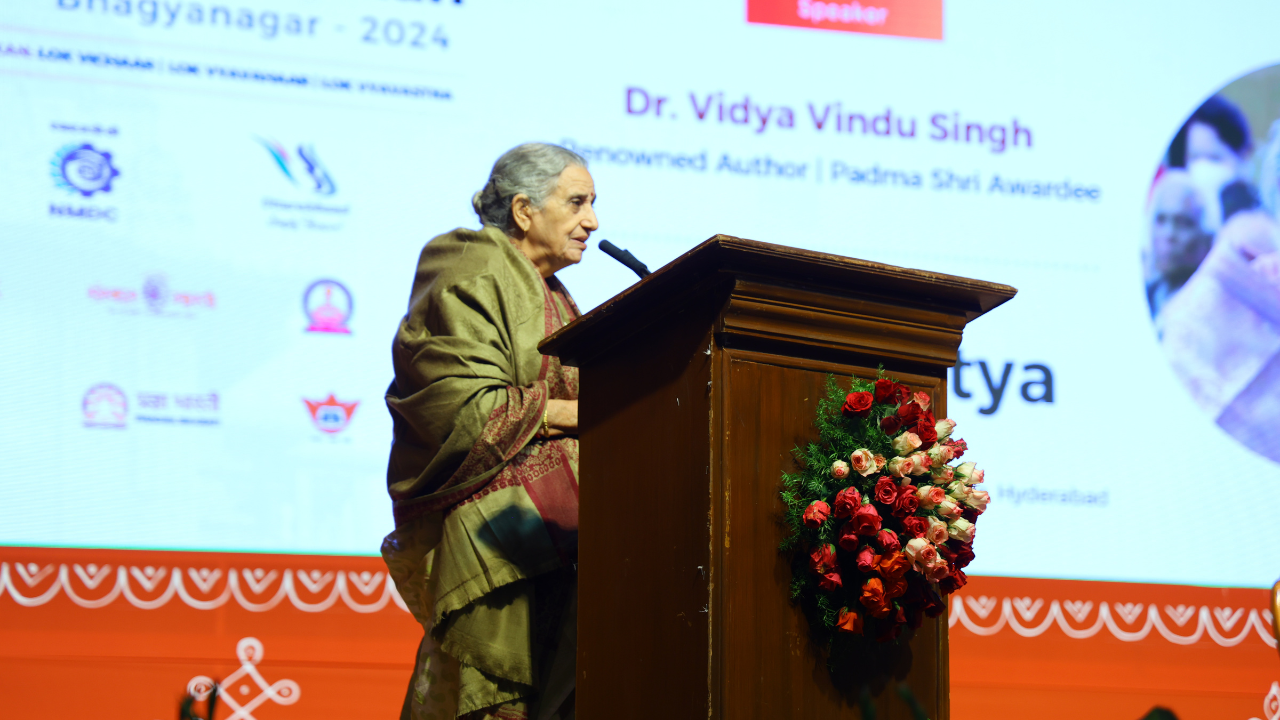
The Power of Lok Narratives in Popular Culture
Vidya Vindu Singh
Author & Padma Shri Awardee
Introduction and Salutations
It’s a true honour to be here today. First and foremost, I must express my deep gratitude to the organisers, my brothers and sisters, for giving me this wonderful opportunity to meet all of you. I bow to you all, and I greet you with the words of Baba Tulsidas, “Avat ki bhoomi se aayi Siyaram mein sab jag jani, karo pranam”-I bow to everyone, knowing that Sita and Ram are present everywhere. I’ve been listening to our brothers discussing stories and episodes from the Ramayana, and it reminds me how deeply the life of Ram is embedded within all forms of our folk literature.
The Enduring Presence of Divinity
In India, our gods are not just figures of the past. They are reborn every day. We feel their presence in every ritual. Every child is born with the essence of Ram and Krishna, and their upbringing is profoundly influenced by these divine figures. From birth to death, this is our culture, our folk culture that has encompassed the entirety of Indian life. We have preserved this through our oral traditions.
The Wisdom and Guidance of Folk Literature
I believe that folk literature provides solutions to every problem. Just like the endless tales of Hari and Hara, this subject is vast. I want to share some thoughts with you. Our folk heritage is rich in both oral and written traditions. It shapes not only the body but also the virtues of a person, guiding us towards goodness and warning against evil. Our folk culture believes in moving towards divinity and away from demonic tendencies.
Environmental Sensitivity in Folk Traditions
Today, we talk a lot about the environment, but the sensitivity our folk culture has shown towards nature is remarkable. I remember my childhood when we were told not to clap our hands in the evening because the birds were settling down to sleep. We were told not to pluck leaves or flowers because they too were asleep. If we needed to draw water from a well at night, we had to wake the well by gently dropping a pebble into it. We’ve lost this sensitivity as we’ve moved away from our folk traditions.
The Role of Literature in National Identity
The identity of our nation is rooted in its literature, which carries its cultural traditions. The diversity of our literature reflects the rainbow of our culture. The importance of art, literature, and culture lies in their ability to give meaning to the world. And folk literature plays a special role in this, providing identity through works in Sanskrit and all our Indian languages, including their dialects.
The Dynamic Nature of Folk Poetry
The poet Ashtavakra said that in literature, there is no old or young. Literature often opposes discipline if it feels stagnant and creates new paths if the old ones no longer serve their purpose. Folk poetry involves risk and joy. Life’s struggles have taken away mental peace, and reality is sometimes presented in a veiled manner and sometimes directly. Folk literature is a medium to unravel inner knots and alleviate restlessness. It’s not just an individual’s experience but a reflection of the collective consciousness of our entire society.
Faith and Modern Sensibilities
Indian life values faith, but today’s frustration, anxiety, and stagnation are seen as modern sensibilities. However, I believe it’s the faith in our folk traditions that can show us the way. Modern sensibilities may be about breaking, but it’s sensitivity and faith that can protect and unite us. Our culture believes in connecting everyone, and this is our identity.
Evolution of Expression and Language
Social changes have altered the way we see and experience things and the voice of the writer has also changed. Those who believe that more modernity brings sensibility, the higher the quality of poetry, will find their thinking one-sided when they connect with folk traditions. Poetry is not about finding a single path or adhering to rigid traditions; it is dynamic. With ideological revolutions, expression and craft have also evolved. New circumstances have brought both sharpness and subtlety to our expressions.
Erosion of Simplicity and Natural Affinity
The biggest negative impact I see is that we are losing the simplicity of our language. The rich heritage of folk consciousness is the essence of collective experience. It skillfully combines the abstract with the concrete. Another adverse effect is that as we move away from folk songs, the natural affinity between humans and nature is diminishing. All relationships are based on long companionship, and human relationships are at the center of everything. In our culture, even inanimate objects are considered alive.
The Call for Unity and Protection
Whenever there is a crisis, our women call upon everyone, addressing them as brothers. For instance, during a fire ordeal, they call upon the blacksmith to forge the iron of dharma, the oil presser to bring the oil of dharma, and so on. All relationships are called upon, and they come to help prove her purity and impartiality. Some realities are becoming monotonous, losing their unique flavor and taste. Due to modern communication methods like mobile phones, our children are unable to distinguish between one leaf and another or one colour and another. music but in the rhythm of life itself. Rhythm means the ebb and flow, where the intensity of love and the depth of pain both have their highs and lows. Recognising this rhythm is recognizing the rhythm of life itself. Today, to expand the tangible intimacy in human relationships and the language that expresses intimacy, it is essential to connect with our country’s oral traditions.
Preservation vs. Living of Folk Traditions
Today, more emphasis is being placed on the preservation of folk literature rather than living it. When we think of preservation, the rich beauty of folk traditions becomes a collectible asset and the essence of experiencing is lost. The sense of beauty is also being dragged into different problematic environments, making the atmosphere increasingly sterile. This void is being filled with film songs. Moving away from folk songs, the richness of life is breaking down.
Timeless Wisdom of Folk Literature
Folk literature reminds us of the past, relieves stress, and gives joy. It keeps the knowledge of time in a natural form. In cities, we are bound by clock time, but in folk traditions, time is connected to work and dates. There is a folk song where a daughter-in-law asks her mother-in-law about the age at which she planted a tree and when she went abroad and has not returned yet. The mother-in-law replies, “I planted the tree when I was young and the river has flown far since then.” Such is the depth of our folk songs.
Sorrow and Raw Life in Folk Languages
There is less rebellion in folk literature and more expression of sorrow. This sorrow is genuine and it truly represents human emotions. It’s also necessary to awaken new anger. Folk languages have a raw life and this should be brought into refined language as well. By recognising ourselves, we can absorb from folk literature without exploiting it.
The Purpose of Ancient Literature and Moral Bonds
Ancient literature presents a world seen, heard, and thought about, all in a meaningful conjunction. We write not to explore but to shape our experiences. In this, there is no intention to unite history with society. The works of Surdas and Tulsidas captivate even ordinary readers, who understand and remember them. Everyone gets something from them, where moral values are evaluated. This is an example of the importance of moral bonds, which everyone understands.
Need for Retrospection and Cultural Unity
For meaningful communication, it’s essential for the writer to address all issues that affect life. We must also consider the relationship between literature and common sensibilities. Today, we have reached a point where it’s necessary to look back. The question of cultural crisis is significant. The word ‘sinhavalokan’ (retrospection) is formed from the behaviour of a lion, which takes two steps forward and then looks back. This looking back is essential to see what we have left behind-our traditional heritage.
Strength of Unity and Folk Mind
Our folk tales have come down through a filtered tradition. A famous tale is that of the wooden bundle, which everyone knows. In practice, we have become separate and thus weaker. Indian culture is not just about humans but about being connected to the entire existence. In folk traditions, there is no distinction between self and others. The folk mind within us thinks for everyone, worries for everyone. It participates in everyone’s joys and sorrows, spreading happiness and alleviating sorrow.
Folk Traditions and Cultural Boundaries
India does not confine itself to geographical boundaries. As far as cultural and intellectual partnerships go and as far as the charge of intimacy is concerned, folk traditions consider it their duty to protect it. Here, even gods are not confined to the pages of history. When we translated Sanskriti as ‘culture’, we became secular. How can we protect dharma while remaining neutral? By connecting with dharma, we protect body, mind and wealth. We started considering dharma as narrow-mindedness and became fragmented. We ran after temptations without thinking, chasing material pleasures, which shook our conscience.
Positive Thinking and Pure Devotion
Shri Ramanujacharya used to worship an idol that had a crack on its back. He was very sad and thought, ‘I worship with so much devotion, how did this happen?’ In a dream, God told him, ‘You have constantly criticized yourself and others, talked about adharma but never about dharma. Our vision does not believe in criticism. It believes in dharma. Why discuss the absence of God? Discuss the presence. More than a critical vision, what we need is pre devotion.’ This story highlights the positive thinking of Indian culture. Indian religiosity is not narrow. For it, dharma has a broad meaning, expanding the world.
Affection and Sensitivity towards Nature
A song always comes to my mind. When Ram left, Mother Kaushalya, in distress, ran after her children, asking everyone, “Did you see my Ram, Lakshman and Sita? Which way did they go?” Whoever she met, she asked. The washerman said, “Yes, they stopped here and I washed and dried their turbans.” She blessed him. She asked the trees, “Did you see my Ram?” The tree said, “Yes, mother, my thorns got entangled in their clothes and they stopped for a while to remove them.” She blessed the tree, saying, “May your roots never dry, no matter how much anyone cuts you.” This blessing of Mother Kaushalya has been received by our culture, which is why this eternal culture continues. This song exemplifies the affection and sensitivity towards nature. Our gods and goddesses are not just historical figures; they are incarnations who come to earth to perform divine acts for human welfare. They are understood through devotion or knowledge. Whatever we receive from our surroundings, we should be grateful for it. This is what folk traditions teach us.
Inclusive Nature of Folk Perspective
In the folk perspective, every living being, animal and plant contains human life. The lifestyle of tribal, hill people and forest dwellers is committed to protecting their body, clan and culture. This is present in both folk and elite cultures. This continuously underscores the importance of world culture. Dharma is a part of culture, embedded in it. It is the recognition of our smallness in the vastness and the endeavor to find the small in the vast. God himself presents himself in a small form, not intimidating with his vastness.
He plays in every mother’s lap and is so intimate that during rituals, songs are sung where even our gods and goddesses are addressed. This intimacy teaches us that we can sit God in front of us and talk to him, even criticise him. Our culture teaches us this. We do not consider tradition as rigid. It has the depth of the past and the roots of renaissance.
Beauty of Motherhood – Maa Sita
In Indian culture, the beauty of a mother is considered the best. There is a folk song where a daughter-in- law talks to her husband and says, “Today I saw a pig and it looked very beautiful.” People consider pigs ugly, but she asks, “What beauty does it have?” Her husband feels she is being sarcastic. The daughter-in- law then prays to the sun and the Ganga to make her a mother. There are many variations of Sita’s form in folk traditions. The story of Sita overshadows the Ramayana in the book I wrote, ‘Sita Sajwa’. In it, Sita’s story becomes the shadow of Ram’s tale, from before Ram’s birth until the sorrow at the Ganges. The folk version of the Ramayana differs slightly from the written version.
Unique Folk Tales and Historical Rethinking
There are unique folk tales, like the one where Taraka ruled Ayodhya for 14 years. I found this tale fascinating. It goes like this: Once, King Dasharatha got lost and reached a forest where he was suffering from hunger and thirst. Taraka quenched his thirst and served him. He revealed that he was the king of Ayodhya and offered her anything she wanted. She asked to rule Ayodhya for 14 years. When Ram killed Taraka, Dasharatha was deeply saddened, saying, “My promise will be broken.” But Ram assured him not to worry and had sandals made from Taraka’s bones, which ruled Ayodhya for 14 years. Such tales make us think deeply. Today, we are calling for the protection of our culture, understanding its crisis and awakening sensitivity. Perhaps the time has come. I am trying to speak about the unity of the country. Our history has not been written impartially. Many songs and folk tales mention the fear of Mughal abductors, where our daughters call upon their brothers and husbands, saying, “Tie the saffron turban, our future is in danger.” When the abductor comes, they say, “Brother, hold the bow, fill your arms with strength.”
The brother replies, “Sister, I tried hard but could notdefeat the abductor.” There is a song of Kusuma from Mathura, where a Mughal abductor takes her away, imprisoning her father and brother. She says, “This is my father’s pond; let me drink two mouthfuls of water before I go.” The abductor says, “the water is dirty, come to my house, where there is gold and silver.” She replies, “No, everything is there at your place, but this pond is rare. I will not see it again.” She drinks one mouthful, then another and at the third, she takes water samadhi (drowns her). When the Mughal throws a net into the pond, it fills with snails and shells. But when her brother throws the net, crying, her nose ring gets caught in it. Such tales make us rethink history.
Importance of Hope and Cultural Identity
If we want to recognise our identity, we must connect with our folk culture. There is a tale of Asha Mai, where a king meets three seated goddesses. He bows to them and they ask, “Whom did you bow to? I am hunger, I am thirst, I am sleep and I am Asha Mai (Hope).” The king says, “I bowed to Asha Mai.” They ask why and he replies, “Hunger can be satisfied with anything, sleep can be found anywhere and thirst can be quenched somewhere, but if hope is lost, everything is lost.” Our Indian culture is a culture of faith.
Conclusion
This is an endless tale and much can be said about it. Time is limited. I am grateful to all of you for listening to me for so long. We will meet again and talk more.
Thank you!
“Our gods and goddesses are not just historical figures; they are incarnations who come to earth to perform divine plays for human welfare.”
– Vidya Vindu Singh
Author & Padma Shri Awardee
Author & Padma Shri Awardee
Introduction and Salutations
It’s a true honour to be here today. First and foremost, I must express my deep gratitude to the organisers, my brothers and sisters, for giving me this wonderful opportunity to meet all of you. I bow to you all, and I greet you with the words of Baba Tulsidas, “Avat ki bhoomi se aayi Siyaram mein sab jag jani, karo pranam”-I bow to everyone, knowing that Sita and Ram are present everywhere. I’ve been listening to our brothers discussing stories and episodes from the Ramayana, and it reminds me how deeply the life of Ram is embedded within all forms of our folk literature.
The Enduring Presence of Divinity
In India, our gods are not just figures of the past. They are reborn every day. We feel their presence in every ritual. Every child is born with the essence of Ram and Krishna, and their upbringing is profoundly influenced by these divine figures. From birth to death, this is our culture, our folk culture that has encompassed the entirety of Indian life. We have preserved this through our oral traditions.
The Wisdom and Guidance of Folk Literature
I believe that folk literature provides solutions to every problem. Just like the endless tales of Hari and Hara, this subject is vast. I want to share some thoughts with you. Our folk heritage is rich in both oral and written traditions. It shapes not only the body but also the virtues of a person, guiding us towards goodness and warning against evil. Our folk culture believes in moving towards divinity and away from demonic tendencies.
Environmental Sensitivity in Folk Traditions
Today, we talk a lot about the environment, but the sensitivity our folk culture has shown towards nature is remarkable. I remember my childhood when we were told not to clap our hands in the evening because the birds were settling down to sleep. We were told not to pluck leaves or flowers because they too were asleep. If we needed to draw water from a well at night, we had to wake the well by gently dropping a pebble into it. We’ve lost this sensitivity as we’ve moved away from our folk traditions.
The Role of Literature in National Identity
The identity of our nation is rooted in its literature, which carries its cultural traditions. The diversity of our literature reflects the rainbow of our culture. The importance of art, literature, and culture lies in their ability to give meaning to the world. And folk literature plays a special role in this, providing identity through works in Sanskrit and all our Indian languages, including their dialects.
The Dynamic Nature of Folk Poetry
The poet Ashtavakra said that in literature, there is no old or young. Literature often opposes discipline if it feels stagnant and creates new paths if the old ones no longer serve their purpose. Folk poetry involves risk and joy. Life’s struggles have taken away mental peace, and reality is sometimes presented in a veiled manner and sometimes directly. Folk literature is a medium to unravel inner knots and alleviate restlessness. It’s not just an individual’s experience but a reflection of the collective consciousness of our entire society.
Faith and Modern Sensibilities
Indian life values faith, but today’s frustration, anxiety, and stagnation are seen as modern sensibilities. However, I believe it’s the faith in our folk traditions that can show us the way. Modern sensibilities may be about breaking, but it’s sensitivity and faith that can protect and unite us. Our culture believes in connecting everyone, and this is our identity.
Evolution of Expression and Language
Social changes have altered the way we see and experience things and the voice of the writer has also changed. Those who believe that more modernity brings sensibility, the higher the quality of poetry, will find their thinking one-sided when they connect with folk traditions. Poetry is not about finding a single path or adhering to rigid traditions; it is dynamic. With ideological revolutions, expression and craft have also evolved. New circumstances have brought both sharpness and subtlety to our expressions.
Erosion of Simplicity and Natural Affinity
The biggest negative impact I see is that we are losing the simplicity of our language. The rich heritage of folk consciousness is the essence of collective experience. It skillfully combines the abstract with the concrete. Another adverse effect is that as we move away from folk songs, the natural affinity between humans and nature is diminishing. All relationships are based on long companionship, and human relationships are at the center of everything. In our culture, even inanimate objects are considered alive.
The Call for Unity and Protection
Whenever there is a crisis, our women call upon everyone, addressing them as brothers. For instance, during a fire ordeal, they call upon the blacksmith to forge the iron of dharma, the oil presser to bring the oil of dharma, and so on. All relationships are called upon, and they come to help prove her purity and impartiality. Some realities are becoming monotonous, losing their unique flavor and taste. Due to modern communication methods like mobile phones, our children are unable to distinguish between one leaf and another or one colour and another. music but in the rhythm of life itself. Rhythm means the ebb and flow, where the intensity of love and the depth of pain both have their highs and lows. Recognising this rhythm is recognizing the rhythm of life itself. Today, to expand the tangible intimacy in human relationships and the language that expresses intimacy, it is essential to connect with our country’s oral traditions.
Preservation vs. Living of Folk Traditions
Today, more emphasis is being placed on the preservation of folk literature rather than living it. When we think of preservation, the rich beauty of folk traditions becomes a collectible asset and the essence of experiencing is lost. The sense of beauty is also being dragged into different problematic environments, making the atmosphere increasingly sterile. This void is being filled with film songs. Moving away from folk songs, the richness of life is breaking down.
Timeless Wisdom of Folk Literature
Folk literature reminds us of the past, relieves stress, and gives joy. It keeps the knowledge of time in a natural form. In cities, we are bound by clock time, but in folk traditions, time is connected to work and dates. There is a folk song where a daughter-in-law asks her mother-in-law about the age at which she planted a tree and when she went abroad and has not returned yet. The mother-in-law replies, “I planted the tree when I was young and the river has flown far since then.” Such is the depth of our folk songs.
Sorrow and Raw Life in Folk Languages
There is less rebellion in folk literature and more expression of sorrow. This sorrow is genuine and it truly represents human emotions. It’s also necessary to awaken new anger. Folk languages have a raw life and this should be brought into refined language as well. By recognising ourselves, we can absorb from folk literature without exploiting it.
The Purpose of Ancient Literature and Moral Bonds
Ancient literature presents a world seen, heard, and thought about, all in a meaningful conjunction. We write not to explore but to shape our experiences. In this, there is no intention to unite history with society. The works of Surdas and Tulsidas captivate even ordinary readers, who understand and remember them. Everyone gets something from them, where moral values are evaluated. This is an example of the importance of moral bonds, which everyone understands.
Need for Retrospection and Cultural Unity
For meaningful communication, it’s essential for the writer to address all issues that affect life. We must also consider the relationship between literature and common sensibilities. Today, we have reached a point where it’s necessary to look back. The question of cultural crisis is significant. The word ‘sinhavalokan’ (retrospection) is formed from the behaviour of a lion, which takes two steps forward and then looks back. This looking back is essential to see what we have left behind-our traditional heritage.
Strength of Unity and Folk Mind
Our folk tales have come down through a filtered tradition. A famous tale is that of the wooden bundle, which everyone knows. In practice, we have become separate and thus weaker. Indian culture is not just about humans but about being connected to the entire existence. In folk traditions, there is no distinction between self and others. The folk mind within us thinks for everyone, worries for everyone. It participates in everyone’s joys and sorrows, spreading happiness and alleviating sorrow.
Folk Traditions and Cultural Boundaries
India does not confine itself to geographical boundaries. As far as cultural and intellectual partnerships go and as far as the charge of intimacy is concerned, folk traditions consider it their duty to protect it. Here, even gods are not confined to the pages of history. When we translated Sanskriti as ‘culture’, we became secular. How can we protect dharma while remaining neutral? By connecting with dharma, we protect body, mind and wealth. We started considering dharma as narrow-mindedness and became fragmented. We ran after temptations without thinking, chasing material pleasures, which shook our conscience.
Positive Thinking and Pure Devotion
Shri Ramanujacharya used to worship an idol that had a crack on its back. He was very sad and thought, ‘I worship with so much devotion, how did this happen?’ In a dream, God told him, ‘You have constantly criticized yourself and others, talked about adharma but never about dharma. Our vision does not believe in criticism. It believes in dharma. Why discuss the absence of God? Discuss the presence. More than a critical vision, what we need is pre devotion.’ This story highlights the positive thinking of Indian culture. Indian religiosity is not narrow. For it, dharma has a broad meaning, expanding the world.
Affection and Sensitivity towards Nature
A song always comes to my mind. When Ram left, Mother Kaushalya, in distress, ran after her children, asking everyone, “Did you see my Ram, Lakshman and Sita? Which way did they go?” Whoever she met, she asked. The washerman said, “Yes, they stopped here and I washed and dried their turbans.” She blessed him. She asked the trees, “Did you see my Ram?” The tree said, “Yes, mother, my thorns got entangled in their clothes and they stopped for a while to remove them.” She blessed the tree, saying, “May your roots never dry, no matter how much anyone cuts you.” This blessing of Mother Kaushalya has been received by our culture, which is why this eternal culture continues. This song exemplifies the affection and sensitivity towards nature. Our gods and goddesses are not just historical figures; they are incarnations who come to earth to perform divine acts for human welfare. They are understood through devotion or knowledge. Whatever we receive from our surroundings, we should be grateful for it. This is what folk traditions teach us.
Inclusive Nature of Folk Perspective
In the folk perspective, every living being, animal and plant contains human life. The lifestyle of tribal, hill people and forest dwellers is committed to protecting their body, clan and culture. This is present in both folk and elite cultures. This continuously underscores the importance of world culture. Dharma is a part of culture, embedded in it. It is the recognition of our smallness in the vastness and the endeavor to find the small in the vast. God himself presents himself in a small form, not intimidating with his vastness.
He plays in every mother’s lap and is so intimate that during rituals, songs are sung where even our gods and goddesses are addressed. This intimacy teaches us that we can sit God in front of us and talk to him, even criticise him. Our culture teaches us this. We do not consider tradition as rigid. It has the depth of the past and the roots of renaissance.
Beauty of Motherhood – Maa Sita
In Indian culture, the beauty of a mother is considered the best. There is a folk song where a daughter-in- law talks to her husband and says, “Today I saw a pig and it looked very beautiful.” People consider pigs ugly, but she asks, “What beauty does it have?” Her husband feels she is being sarcastic. The daughter-in- law then prays to the sun and the Ganga to make her a mother. There are many variations of Sita’s form in folk traditions. The story of Sita overshadows the Ramayana in the book I wrote, ‘Sita Sajwa’. In it, Sita’s story becomes the shadow of Ram’s tale, from before Ram’s birth until the sorrow at the Ganges. The folk version of the Ramayana differs slightly from the written version.
Unique Folk Tales and Historical Rethinking
There are unique folk tales, like the one where Taraka ruled Ayodhya for 14 years. I found this tale fascinating. It goes like this: Once, King Dasharatha got lost and reached a forest where he was suffering from hunger and thirst. Taraka quenched his thirst and served him. He revealed that he was the king of Ayodhya and offered her anything she wanted. She asked to rule Ayodhya for 14 years. When Ram killed Taraka, Dasharatha was deeply saddened, saying, “My promise will be broken.” But Ram assured him not to worry and had sandals made from Taraka’s bones, which ruled Ayodhya for 14 years. Such tales make us think deeply. Today, we are calling for the protection of our culture, understanding its crisis and awakening sensitivity. Perhaps the time has come. I am trying to speak about the unity of the country. Our history has not been written impartially. Many songs and folk tales mention the fear of Mughal abductors, where our daughters call upon their brothers and husbands, saying, “Tie the saffron turban, our future is in danger.” When the abductor comes, they say, “Brother, hold the bow, fill your arms with strength.”
The brother replies, “Sister, I tried hard but could notdefeat the abductor.” There is a song of Kusuma from Mathura, where a Mughal abductor takes her away, imprisoning her father and brother. She says, “This is my father’s pond; let me drink two mouthfuls of water before I go.” The abductor says, “the water is dirty, come to my house, where there is gold and silver.” She replies, “No, everything is there at your place, but this pond is rare. I will not see it again.” She drinks one mouthful, then another and at the third, she takes water samadhi (drowns her). When the Mughal throws a net into the pond, it fills with snails and shells. But when her brother throws the net, crying, her nose ring gets caught in it. Such tales make us rethink history.
Importance of Hope and Cultural Identity
If we want to recognise our identity, we must connect with our folk culture. There is a tale of Asha Mai, where a king meets three seated goddesses. He bows to them and they ask, “Whom did you bow to? I am hunger, I am thirst, I am sleep and I am Asha Mai (Hope).” The king says, “I bowed to Asha Mai.” They ask why and he replies, “Hunger can be satisfied with anything, sleep can be found anywhere and thirst can be quenched somewhere, but if hope is lost, everything is lost.” Our Indian culture is a culture of faith.
Conclusion
This is an endless tale and much can be said about it. Time is limited. I am grateful to all of you for listening to me for so long. We will meet again and talk more.
Thank you!
“Our gods and goddesses are not just historical figures; they are incarnations who come to earth to perform divine plays for human welfare.”
– Vidya Vindu Singh
Author & Padma Shri Awardee