
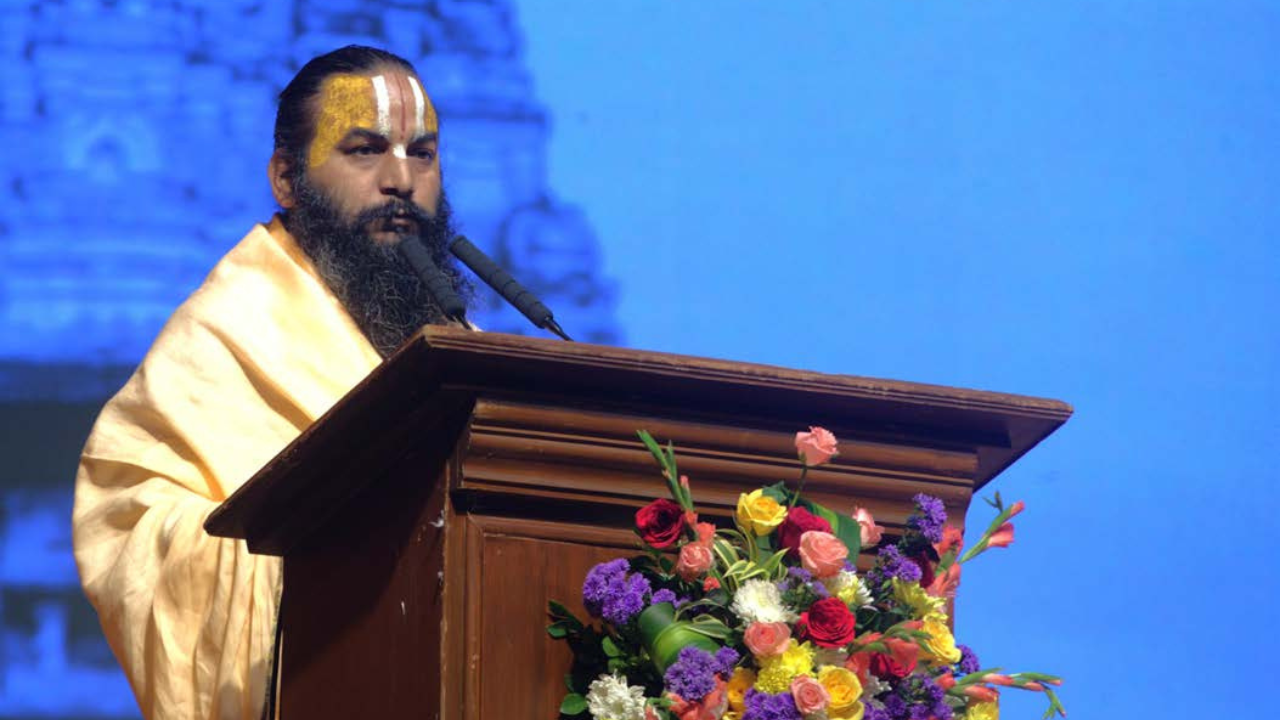
Acharya Mithilesh Nandini Sharan ji
Mahant, Hanuman Garhi, Ayodhya
Om Namo Bhagwate Uttam Lokaya Namah,
Arya Lakshan Shal Vrata Namah,
Upashikshit Atman, Upas Lokaya Namah,
Sadhuvad Ni Kashaya Namo,
Brahmanaya Devaya Mahapurushaya Maharajaya Namah.
“You are the protector in times of crisis, the saviour of all wealth, the beloved of the world, Shri Ram. We bow to you.”
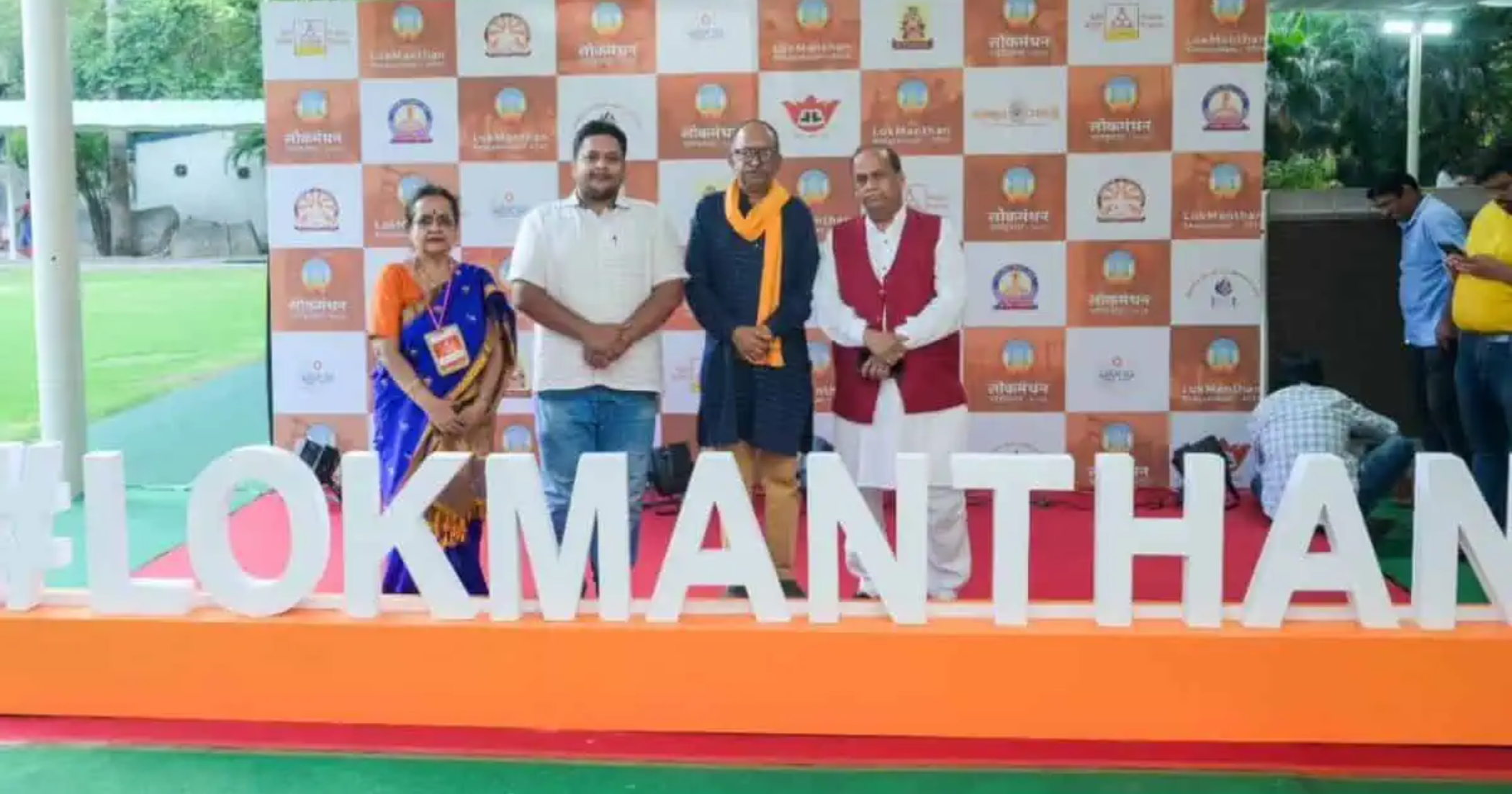
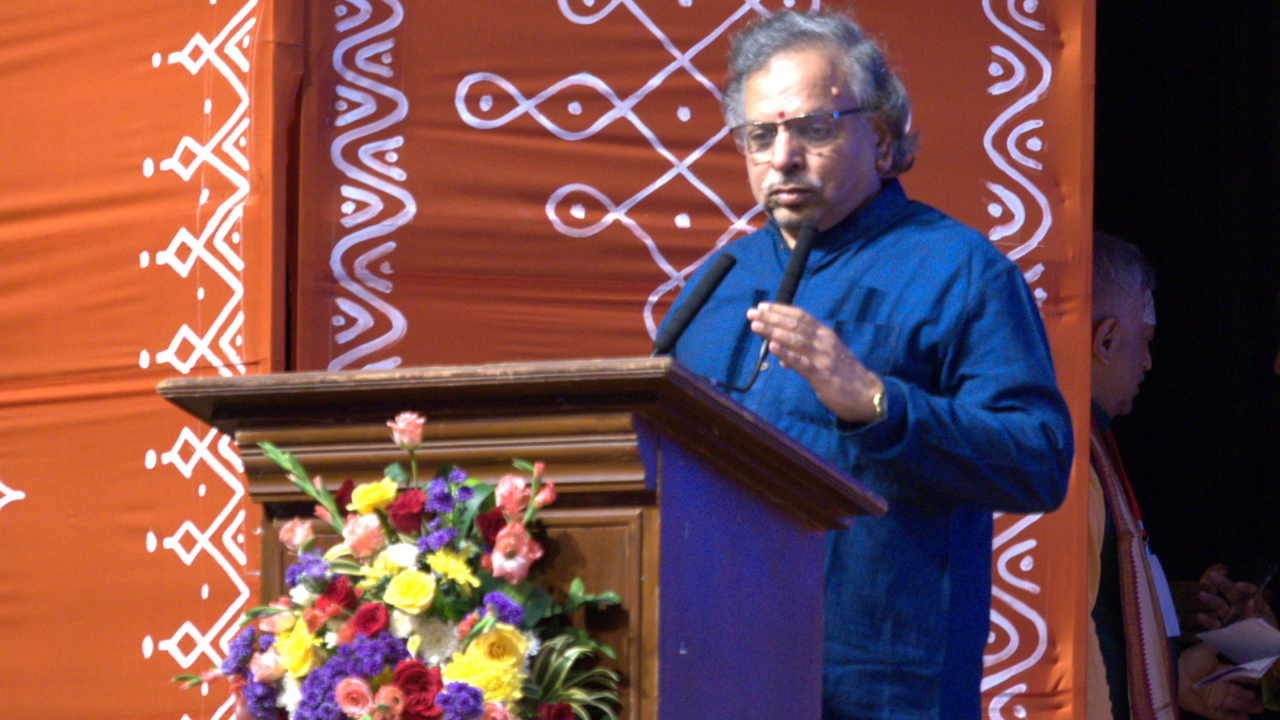
We bow to this great endeavour of Lokmanthan (churning of the people) at this event and especially to the concluding session on this stage. We also bow to the minds of the people of India and the Indian diaspora worldwide. Together, with all those who wish for the upliftment of India, we offer our respects to the Rashtriya Swayamsevak Sangh (RSS) and its respected Sarsanghchalak, Dr. Mohan Bhagwat ji. We are also honoured by the presence of Smt. Nirmala Sitharaman ji, the Finance Minister of India, Shri Gajendra Singh Shekhawat ji, the Minister of Tourism and Culture, Government of India, as well as Shri Kishan Reddy ji and Shri J. Nandakumar ji, who made Lokmanthan 2024 possible. Shri Prafulla Ketkar ji chairs this session. I may have missed a few names, either due to oversight or for the sake of time. We are privileged to have with us experts from various fields, participants, speakers and all gathered to reflect on the progress of our nation, its personality, its character and to bring clarity to our role in defining a glorious Bharat.
Over the past 3-4 days, we have heard and understood many things. This gathering is composed of wise and learned individuals, so I do not wish to deliver a lecture today. However, I would like to share a few thoughts.
Lokabhiramam
One important point that has been emphasized here is that without Ayodhya, the idea of Lok Mangal (welfare of the people) cannot be fully realised, at least not for India. This is why the glory of Lord Shri Ram is so widely celebrated, and one of the most highlighted terms is Lokabhiramam.
I will share a few points in brief, and if it feels like I am taking too much time, kindly signal me. What is Lok? In the Vaishnava tradition of the South, a great Acharya, in his Shri Stava, says, “Lok Vanaspati Brihaspati Taratamya Yasya Kataksha Parinama Mudhah Harati Sa Bharati Bhagwati.”
This means that Lok is where everything, from Vanaspati (plants) to Brihaspati (the divine), exists in harmony. Lok is that which harmoniously embraces everything within itself and assimilates it because it is Prakriti (nature). To define Lok, we must understand it in three dimensions: Prakriti (nature), Vikriti (distortion), and Sanskriti (culture).
Prakriti, Vikriti and Sanskriti
Lok expresses itself through a transcendental entity, which is referred to in Indian philosophy as Sarvam Khalvidam Brahma. The same sages who describe the distinctions in Lok also prescribe the acceptance of both Vidhi (rules) and Nishedh (prohibitions). They do this because when the transcendental entity expresses itself through Lok, it manifests in both Prakriti and Vikriti. There are many ideologies in the world that consider Vikriti as natural and advocate for its acceptance. I will not delve into this now, but I trust you can understand. Prakriti creates, and in the journey of life, in the context of time and space, many signs of Prakriti appear as distortions. The process of transforming these distortions back into Prakriti is called Sanskriti.
Bharat—A Cultural Nation
Bharat is a culture-based nation, not a civilization-based one. Unfortunately, due to global influences, we are becoming civilization-oriented. Civilization is an external and artificial quality, while culture is internal and fundamental. When we recognize this culture, we see that it is rooted in Dharma. You may ask why this is so. The answer lies in the fact that Shri Ram is both Lokabhiramam and Dharmavigrah (the embodiment of Dharma). To simplify, whatever is Prakriti, when distorted, is restored through Sanskriti, and the fundamental principle for this restoration is Dharma. Dharma is the concept of maintaining existence in its fundamental state. Dharma is the promise to stabilize everything in its true form. Due to differences in conduct and the influence of time and place, we have declared certain practices as Dharma, leading to debates and conflicts worldwide. But Dharma itself does not cause conflict.
Vedas—The Ultimate Source
I am not speaking solely in the context of humans, but of all existence, both animate and inanimate. As long as every particle of the universe remains in its Dharma, it cannot harm anyone. Distortions occur when something deviates from its Dharma, and Sanskriti restores it. The essence of Lok is to assimilate everything through Prakriti, not Vikriti, and to have the wisdom to discern what is Prakriti and what is Vikriti. This wisdom comes from the Vedas in India. The complexity of understanding the Vedas is explained through Smriti, Itihasa, and Purana.
The Churning Process
Another term being used here is manthan (churning). You are engaged in Lokmanthan. India is familiar with Manthan, and many Manthans have taken place in the past. One well-known Manthan is the Samudra Manthan (churning of the ocean), which resulted in the emergence of many treasures, including Amrit (nectar). But there is another Manthan, less known but still present in our lives: the Arani Manthan. While Samudra Manthan brought forth gems, Arani Manthan brought forth Agni (fire). What will Lokmanthan bring forth? First, we must understand what Manthan means.
Delectable Manthan
The scriptures say that manthan means to soften something hard, to turn it into powder or liquid, to simplify it. Manthan is the process of breaking down traditions and practices that have become rigid over generations. Just as blood clotting in the body can lead to severe diseases, in society, some traditions become rigid and distorted. Manthan softens these rigid traditions and facilitates dialogue. For example, consider curd: set curd is dense, but when churned, it yields butter and every particle of the curd becomes fluid. Similarly, when we engage in Lokmanthan, two things come to the forefront. One important question raised earlier was, “How did we come to consider those who fought for us, who were warriors, as untouchables? How did we push them out of the mainstream?” I want to clarify that this is not something we have done—it is a colonial distortion.
In any journey, such things can happen due to temporary circumstances. Over time, these practices lose their meaning, and society begins to reject them. When society rejects them, these practices find their own path, often not properly defined and they drift away. This is natural. Just as unused rooms in a house gather dust, societal practices become outdated.
Amrit-Lokamanya Purpose
When we engage in Lokmanthan, like the Samudra Manthan, we leave behind many treasures, but two important outcomes emerge. One is Amrit (nectar)
and the other is vish (poison). Those who seek Amrit must be prepared to face Vish. In Lokmanthan, the Vish that emerges is division: divisions of caste,
language, class, traditions, and customs. The Amrit that emerges is unity. When the rigidity is broken through Manthan, unity is revealed.
Surface Divisions
In a previous session, a point was made about philosophy. I will conclude by referencing that point. In Shri Ram Rajya, divisions exist only in Natya Shastra (the art of drama), as said by Goswami Tulsidas ji. This is an ornament where countless flaws and ornaments are placed appropriately, transforming flaws into virtues. A thorn is a flaw, but where it is placed matters. Smoke is a flaw, but where it is placed matters. In a drama troupe, an actor playing a king knows that it is just a role. Similarly, in Natya Shastra, divisions are depicted, but the underlying message is that divisions are not real; unity is real. To live with this understanding is the essence of Shri Ram’s vision for Lok.
Well-being of All Begins
When Shri Ram went to Lanka to fight Ravana, he did not call upon the army of Ayodhya or the army of the gods. Those who fought for Shri Ram were not citizens of Ayodhya, nor did they have any claim to the benefits of Ram Rajya. Why did they fight? Shri Ram, by renouncing his kingdom and living in the forest, had resolved to heal the suffering of all beings, both animate and inanimate. The result was that even snakes did not bite him and the mischievous monkeys became thoughtful advisors and sacrificial warriors. When our communication, our message and our empathy become so profound that even those who are not direct beneficiaries of our struggle are willing to sacrifice for our cause, we can say that our Lokmanthan has been successful. As long as only beneficiaries stand with you, your message has not reached the people. A line from the respected Sarsanghchalak ji comes to mind: “If you come to the Sangh to take something, do not come.” This is the vow of Lord Shri Ram. Maharishi Veda Vyas said:
“Smar Kakam Hrid Vinashya Vidamate.”
Lord Shri Ram returned to his divine abode, leaving behind a message: “If you can sacrifice yourself, follow me.”
Lokamanthan—Healing Touch
The essence of Lokmanthan is to be committed to alleviating the suffering of the people, to offer oneself. This is not just about thoughts but also about actions. You are blessed to be engaged in this endeavor in all its dimensions. You have invited us here and given us this opportunity. For this, we thank you. With the Lokabhiramam of Lord Shri Ram, we pray that this Lokmanthan heals the wounds of the people, restores India’s glory and light, and thereby illuminates the world.
Jai Siya Ram!
“You are the protector in times of crisis, the savior of all wealth, the beloved of the world, Shri Ram. We bow to you.”
– Acharya Mithilesh Nandini Sharan ji